
For weeks, the war skirted the edge of catastrophe without tipping over. Missiles flew, there was much destruction, commanders were assassinated, cities across the Gulf and even in Israel struggled to absorb the shock. But one line held: Energy infrastructure, the arteries of the global economy, remained largely untouched. That is no longer true. Prem Panicker continues his must read daily blog on the Gulf War.

Drones may have been used for non-lethal purposes but state-sponsored assassinations and semi-covert wars are fuelling their boom and not scientific missions or creative activists, says American political activist Medea Benjamin.

Trump may strike. He may announce productive talks and extend again. He may do both at the same time. Iran will not open the Strait on someone else's terms, so no matter what happens, that problem will remain unsolved. And the IRGC will still be collecting its $2 million toll from every ship bold enough to ask permission to pass.
'Unfortunately, India and Pakistan could learn a 'lesson' from this conflict that will make them more likely to use these weapons against each other in the future.' 'Rounds of missile and drone attacks could be more routine features of their hostility, just like artillery fire has become a familiar fact of life along the Line of Control.'

A top military official has revealed details about India's proposed air defence system, Sudarshan Chakra, describing it as a comprehensive system that will include counter-drone, counter-UAV, and counter-hypersonic capabilities.
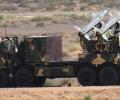
India's indigenously developed 'Akashteer' air defense system performed exceedingly well during 'Operation Sindoor,' according to Defence Research and Development Organisation (DRDO) chief Samir V Kamat. The fully automated system, deployed against terror sites in Pakistan and Pakistan-occupied Kashmir, integrates various radar systems, sensors, and communication technologies. Kamat expressed confidence in the system's success drawing international interest, highlighting India's progress toward self-reliance in the defense sector. He also addressed the future of warfare, emphasizing the need for a blend of traditional and emerging technologies, and outlined the development timeline for the indigenous 5.5-generation stealth fighter aircraft, the Advanced Medium Combat Aircraft (AMCA).

The officials said helicopters and drones were pressed into the service to help the forces, who are also using human and technical intelligence inputs to aid the search operation which has been launched to trace and neutralise the terrorists behind the attack.

The 'rescue' operation occurred within kilometres of Iran's underground tunnel complex at Isfahan, assessed by the IAEA and US intelligence as holding a substantial portion of the country's 60 per cent enriched uranium stockpile. Retired senior US military officers have highlighted that the mission's footprint -- hundreds of special operators, multiple heavy-lift aircraft deep inside Iran -- appears outsized for recovering a single airman. Prem Panicker continues his must read blog on the Iran War.

Chief of Defence Staff General Anil Chauhan emphasized the need for constant high military preparedness, citing Operation Sindoor as an ongoing example. He also highlighted the importance of 'information warriors, technology warriors and scholar warriors' in future warfare.
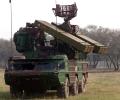
The Indian Army is conducting field trials of several cutting-edge defence systems under 'near-combat conditions', integrating electronic warfare simulations, to assess their performance rigorously, officials said on Saturday.

Chief of Defence Staff Gen Anil Chauhan asserted that the armed forces are free of nepotism and urged children to join to serve the nation. He also spoke about Operation Sindoor and the use of technology in warfare.

When missiles fly in this region, they are never just aimed at military targets.
In 2025, India launched Operation Sindoor, a multi-domain combat mission against Pakistan in response to cross-border terrorism. The operation involved precision strikes, military retaliation, and diplomatic measures, marking a significant shift in India's security policy.

Zelenskyy further said that the assault occurred overnight and into the morning, and involved a barrage of approximately 120 missiles and 90 drones, including Shaheds, Zircons, Iskanders, and Kinzhals.
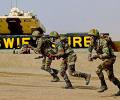
The Indian Army's broader reorganisation is inevitable as India's military doctrine adapts to the demands of the modern battlefield.

Amid freezing temperatures and treacherous terrains, the Indian Army has intensified its counter-terrorism operations across Kishtwar and Doda districts in Jammu and Kashmir to pursue and neutralise Pakistani terrorists attempting to exploit the harsh winter for concealment, sources said on Saturday.

The largest tranche came in July, in the wake of Operation Sindoor, with the DAC according acceptance of necessity -- or initial approval -- for 10 capital acquisition proposals amounting to approximately 1.05 trillion through indigenous sourcing.

China displayed a range of new weapons at a military parade, including laser weapons, nuclear ballistic missiles, giant underwater drones, and fifth-generation aircraft.
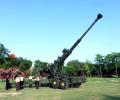
The Indian government outlines its futuristic defence programme, Sudarshan Chakra Mission, focusing on indigenous development, predictive technologies, and targeted counter-action systems to enhance national security.

Chief of Defence Staff Gen Anil Chauhan identifies China border dispute as India's biggest national security challenge, followed by Pakistan's proxy war. He also highlighted regional instability, future warfare scenarios, and dealing with nuclear-armed adversaries as major concerns.

Former Punjab Chief Minister Amarinder Singh criticizes the BJP's functioning, stating he is not being consulted. He rules out rejoining the Congress but expresses willingness to help Sonia Gandhi personally. He also discusses Punjab's political landscape, AAP's performance, and national security.
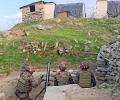
'With a military-led strategy to counter terrorism emanating from Pakistan, India has clearly signalled that it would respond decisively to future terrorist threats.'
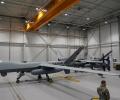
India is procuring the long-endurance 'hunter-killer' drones to crank up the surveillance apparatus of the armed forces, especially along the Line of Actual Control with China.

The drones were destroyed using electronic warfare measures and caused no casualties or damage, the press service added.

'Fears in Washington began to intensify when it was realised that subsequent Pakistani and Indian attacks on major military facilities -- which were significant in terms of geographic scope and intensity -- could rapidly take both sides to where neither actually wanted to go.' 'The US objective was to stop the fighting as soon as possible. Everything else was secondary.'

'An important consideration was that we should always be at the top of the escalation ladder. When we reach a military objective, we should try and put a stop to it'
When the technology gap between China and India will remain large, cost-effective hardware of the kind that proved their worth in Operation Sindoor should be our priority, points out R Jagannathan.
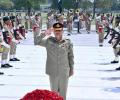
Creating a powerful new chief of defence forces has split the Pakistan military into four competing factions, points out Rana Banerji, who headed the Pakistan desk at RA&W.

The Defence Acquisition Council (DAC) has approved military projects worth approximately Rs 67,000 crore, including drones, radars, and missile systems, aimed at enhancing India's military capabilities.
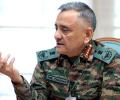
Chief of Defence Staff General Anil Chauhan on Saturday said India's Operation Sindoor has drawn a 'new red line' of intolerance against terror, and expressed hope that the military action has brought 'some lessons for our adversary also'.
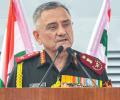
Possible convergence of interest among China, Pakistan, and Bangladesh may result in serious implications for India's stability and security dynamics, Chief of Defence Staff General Anil Chauhan said on Tuesday.

'An armed helicopter equipped with counter-drone systems will provide the airborne counter-drone capability and flexibility needed to protect India's critical assets.'
'This operation was a culmination of such long (period) of efforts, and gives us satisfaction that whatever we have been doing, we have been doing correctly'

China supplied more than $20 billion worth of arms to Pakistan. These include 20 J-10CE and JF-17 Block III fighter aircraft, Wing Loong drones, frigates, submarines, Hongqi HQ-9P surface-to-air missiles, 240 PL-15E air-to-air missiles, LY-80 air defence systems, ZDK early warning aircraft and other weapons.
The Agency said it has delivered the required certification notifying Congress of this possible sale on Thursday.

'The (Maoist) organisation is in visible decline. Their senior leaders are ageing. Forest life is unforgiving -- older leaders simply cannot cope physically.' 'Earlier, they attracted educated youth from cities. That stream has dried up. Today's recruits largely come from poor village backgrounds and lack ideological depth.'

After Operation Sindoor, the Army and Navy now view the IAF as not a supporting arm, but the spearhead of India's warfighting capability, capable of decisive outcomes across domains, explains Air Commodore Nitin Sathe (retd).
It said the acceptance of necessity accorded to the procurement by the Defence Acquisition Council noted the estimated cost of $3,072 million as provided by the US government, adding the price will be negotiated once policy approval from Washington is received.
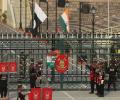
In the India-Pakistan situations, off-ramps have come either through foreign mediation (after months of kinetic warfare over Kargil, and a long stand-off with Op Parakram) or when a situation made it possible for both sides to claim a win, explains Shekhar Gupta.

Army Chief General Upendra Dwivedi asserted that Operation Sindoor was unlike any conventional mission and that it was akin to playing a game of chess as 'we did not know' what would be the enemy's next move.
